
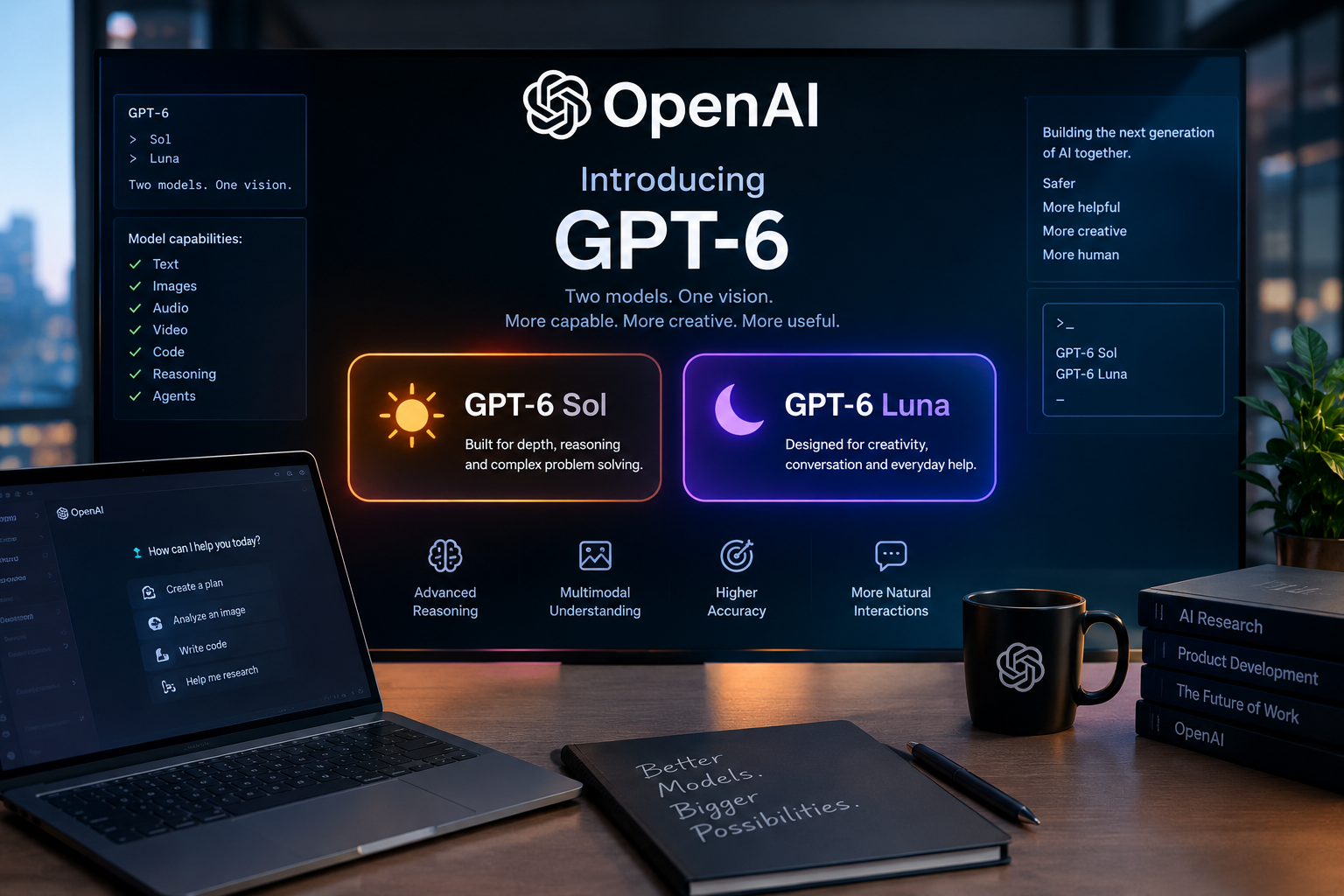
OpenAI has expanded its GPT-6 family with two new models: GPT-6 Sol and GPT-6 Luna.
The models were announced on September 22, 2026, following the earlier release of GPT-6 Astra. OpenAI describes Sol and Luna as models that bring capabilities developed for Astra into faster and more affordable options designed for everyday work and development at scale.
The release is important because the AI industry is no longer focused only on creating increasingly large and expensive frontier models. Cost, speed, reasoning performance and the ability to run AI at scale are becoming equally important for developers and businesses.
OpenAI says GPT-6 Sol and GPT-6 Luna also benefit from improvements in inference efficiency and caching. According to the company’s announcement, the API pricing for the two models is 50% lower than the promotional pricing of their GPT-5.6 predecessors.
So what are GPT-6 Sol and GPT-6 Luna, how are they different, and what do they mean for AI users and developers?
What Are GPT-6 Sol and GPT-6 Luna?
GPT-6 Sol and GPT-6 Luna are reasoning models in OpenAI’s GPT-6 family.
They are designed for different balances between capability, speed and cost.
OpenAI says both models build on advances introduced with GPT-6 Astra while making those capabilities more accessible for everyday workloads and large-scale applications.
The models are available through OpenAI’s API and have also been introduced into selected OpenAI products.
According to OpenAI’s API changelog, both models accept text and image inputs and generate text through the Responses and Chat Completions APIs.
That makes them useful for more than traditional text-only chatbot applications.
GPT-6 Sol vs GPT-6 Luna
The simplest way to understand the two models is to think about their position within the same family.
| Feature | GPT-6 Sol | GPT-6 Luna |
|---|---|---|
| Model family | GPT-6 | GPT-6 |
| Reasoning model | Yes | Yes |
| Text input | Yes | Yes |
| Image input | Yes | Yes |
| API availability | Yes | Yes |
| Main focus | Higher capability workloads | Lower-cost, scalable workloads |
| Standard input price* | $2 / 1M tokens | $0.10 / 1M tokens |
| Standard output price* | $10 / 1M tokens | $0.50 / 1M tokens |
*Standard API pricing for prompts with up to 272K input tokens, according to OpenAI’s September 2026 API changelog. Additional processing tiers and cache pricing can differ.
The large pricing difference means developers can select a model according to the requirements of a particular application instead of using the same model for every task.
GPT-6 Sol: Designed for More Demanding Work
GPT-6 Sol is positioned toward users and developers who need more capability while still wanting lower costs than OpenAI’s earlier GPT-5.6 promotional pricing.
OpenAI says Sol brings many of the advances behind Astra into a model designed for work at scale.
Potential use cases include:
- Complex reasoning
- Software development
- Data analysis
- Document processing
- Image understanding
- AI assistants
- Business applications
- Agent workflows
- Research tasks
The exact performance of Sol depends on the workload and implementation, so developers should evaluate it against their own tasks rather than assuming benchmark results automatically translate to every application.
GPT-6 Luna: Lower-Cost AI at Scale
GPT-6 Luna takes a different approach.
Its standard API price is substantially lower than Sol’s, making it particularly relevant for applications that need to process large numbers of requests.
OpenAI lists standard pricing of $0.10 per million input tokens and $0.50 per million output tokens for Luna under the specified pricing conditions.
That could make Luna useful for applications such as:
- Customer support
- Text classification
- Content transformation
- Summarization
- Information extraction
- AI-powered search
- High-volume automation
- Developer tools
- Educational applications
Lower token costs can make it easier for developers to experiment with AI features without the same per-request expense associated with larger models.
Why AI Model Pricing Matters
AI pricing has become an important part of software development.
A company may have an excellent AI idea, but if processing costs are too high, deploying it to thousands or millions of users may not be practical.
Consider a simple example.
A service receives millions of AI requests every month.
Using a high-cost model for every request could create a significant operating expense.
A lower-cost model can potentially handle simpler tasks while a more capable model is reserved for complex requests.
This creates a model-routing strategy.
For example:
Simple task → GPT-6 Luna
Complex reasoning → GPT-6 Sol
Highly demanding workflow → More capable frontier model
The exact routing strategy depends on the application’s requirements, but the availability of different price-performance levels gives developers more flexibility.
Multimodal Input With Text and Images
Both GPT-6 Sol and GPT-6 Luna support text and image inputs through the API.
This means developers can build applications that work with more than written prompts.
Possible applications include:
- Image analysis
- Document understanding
- Visual question answering
- Screenshot analysis
- Product image processing
- Visual search
- Software interface analysis
For example, a customer support application could allow a user to upload a screenshot of an error message.
Instead of requiring the user to describe the problem entirely through text, the AI system can analyze the image as part of the request.

GPT-6 Models and AI Coding
Software development is one of the major areas where reasoning models are becoming increasingly important.
Developers can use AI models to help with:
- Writing code
- Explaining code
- Finding bugs
- Creating tests
- Refactoring
- Documentation
- Debugging
- Code review
- Understanding unfamiliar projects
OpenAI has also made GPT-6 Sol and Luna available in Codex and other development environments.
However, developers should still review generated code carefully.
AI can produce code that looks correct while containing logic errors, security problems or assumptions that do not match the project.
GPT-6 Sol and Luna in AI Applications
The lower pricing structure could be especially relevant to software companies building AI-powered applications.
Instead of using AI only as a standalone chatbot, developers can integrate models directly into their products.
For example:
Productivity Software
AI can summarize documents, generate drafts and help users analyze information.
Customer Support
AI can classify incoming requests and generate suggested responses.
Education
AI can explain concepts, create practice questions and analyze uploaded material.
Business Analytics
AI can help users interpret data and generate natural-language summaries.
Developer Tools
AI can assist with programming, debugging and code documentation.
The important distinction is that these applications can use AI as a component inside a larger software product.
What Changed From GPT-5.6?
OpenAI says GPT-6 Sol and Luna build on advances from GPT-6 Astra and improve the balance between intelligence, efficiency and cost.
The models are therefore not simply positioned as minor updates.
They represent a broader strategy in which a model family provides multiple capability and price levels.
This is increasingly common across the AI industry.
Developers do not always need the most powerful available model.
For many tasks, a smaller or less expensive model may provide sufficient quality.
GPT-6 Astra, Sol and Luna
OpenAI’s GPT-6 family now includes multiple models with different purposes.
GPT-6 Astra
Astra is positioned as OpenAI’s highest-capability model and was introduced on September 3, 2026.
OpenAI says Astra is designed for demanding computer use, browsing, software engineering, cybersecurity, science and professional work.
OpenAI also says Astra reached its Critical cybersecurity capability threshold under its Preparedness Framework, which led to stronger safeguards around the model.
GPT-6 Sol
Sol provides a balance between advanced capability and cost.
It is intended for demanding workloads that may not require Astra.
GPT-6 Luna
Luna focuses more heavily on cost efficiency and high-volume use cases.
This gives developers more options when designing AI systems.
GPT-6 Sol and Luna API Pricing
Pricing is one of the most important details for developers.
According to OpenAI’s September 22 API changelog:
GPT-6 Sol
- Input: $2 per million tokens
- Cached input: $0.20 per million tokens
- Output: $10 per million tokens
GPT-6 Luna
- Input: $0.10 per million tokens
- Cached input: $0.01 per million tokens
- Output: $0.50 per million tokens
These are standard rates for prompts with up to 272K input tokens. OpenAI notes that longer prompts and other processing options can have different rates.
Developers should therefore check the current API pricing before estimating production costs.
What Are Cached Tokens?
Caching can reduce costs when the same information is repeatedly provided to a model.
For example, an application may repeatedly use the same system instructions, documentation or reference material.
If eligible content is cached, developers can potentially pay less for repeated input.
OpenAI lists separate cached-input rates for GPT-6 Sol and Luna.
For applications making large numbers of requests, efficient caching can become an important part of AI cost management.
Why Lower-Cost AI Models Matter for Developers
The AI industry is moving toward a more diverse model ecosystem.
Not every application needs the most powerful model.
Imagine a software company building an AI customer-support system.
It might use a lower-cost model for:
- Identifying the topic
- Classifying the request
- Summarizing simple conversations
A more capable model could then handle:
- Complex troubleshooting
- Multi-step reasoning
- Difficult customer cases
- High-value business requests
This approach can reduce unnecessary AI spending while preserving more advanced capabilities where they matter.
GPT-6 Sol and Luna for Businesses
Businesses are increasingly integrating AI into existing workflows.
Instead of asking employees to manually copy information between systems, AI can help process documents, classify information and generate outputs.
Possible business applications include:
- Financial document analysis
- Sales assistance
- Internal knowledge search
- Customer support
- Marketing workflows
- Software development
- Research
- Data analysis
- Document automation
However, businesses should consider privacy, access controls, compliance and human review before placing sensitive information into AI systems.

Privacy and Data Considerations
AI models can process highly sensitive information.
Depending on the application, users may provide:
- Business documents
- Customer information
- Financial records
- Source code
- Internal communications
- Personal data
Developers should understand the data policies and retention settings applicable to the API or product they are using.
OpenAI states that eligible API customers can use Zero Data Retention for GPT-6 Astra, while the exact privacy and retention conditions depend on the product and customer configuration.
Organizations should therefore review the applicable documentation rather than assuming every AI service handles data in the same way.
Limitations of GPT-6 Sol and Luna
Newer AI models still have limitations.
AI Can Make Mistakes
Reasoning models can produce incorrect information or flawed conclusions.
More Capability Does Not Mean Perfect Accuracy
Even advanced models can misunderstand instructions or context.
Human Review Remains Important
High-impact decisions should not automatically be delegated to AI.
Costs Can Still Grow
Low token prices do not mean an AI application is automatically cheap.
High usage volumes can create significant costs.
Integration Requires Engineering
Using an AI model inside a real application requires authentication, monitoring, error handling, security and testing.
How Developers Should Evaluate GPT-6 Models
Instead of choosing a model only because it is new, developers should test it against real workloads.
Useful evaluation areas include:
- Accuracy
- Latency
- Cost
- Reliability
- Tool use
- Image understanding
- Coding performance
- Long-context behavior
- Safety
- Failure rates
A model that performs well on a public benchmark may not necessarily be the right choice for a specific application.
The best evaluation is based on representative tasks from the actual product.
The Future of AI Models
The release of GPT-6 Sol and Luna illustrates an important direction in artificial intelligence.
AI companies are increasingly building model families instead of relying on a single model.
Different models can serve different requirements:
- Maximum capability
- Lower latency
- Lower cost
- High-volume workloads
- Specialized tasks
- Local or edge applications
This approach may become increasingly important as businesses move from experimenting with AI to deploying it across real products.
What GPT-6 Sol and Luna Mean for Everyday AI Users
Most people do not interact directly with an API.
Instead, they encounter AI models through applications.
A model improvement can therefore appear indirectly as:
- Better writing
- Faster responses
- Better image understanding
- More useful coding assistance
- Improved productivity tools
- More capable AI assistants
The model itself may be invisible to the user.
What matters is how software companies use the underlying technology.
Frequently Asked Questions
What are GPT-6 Sol and GPT-6 Luna?
GPT-6 Sol and GPT-6 Luna are OpenAI reasoning models introduced in September 2026. They build on advances from GPT-6 Astra while targeting different balances of capability and cost.
When were GPT-6 Sol and Luna released?
OpenAI announced GPT-6 Sol and GPT-6 Luna on September 22, 2026. Both were released through the API and introduced into selected OpenAI products.
How much does GPT-6 Luna cost?
OpenAI’s standard API pricing lists GPT-6 Luna at $0.10 per million input tokens and $0.50 per million output tokens under the specified pricing conditions.
How much does GPT-6 Sol cost?
OpenAI lists GPT-6 Sol at $2 per million input tokens and $10 per million output tokens under its standard pricing for prompts within the stated input limit.
Can GPT-6 Sol and Luna understand images?
Yes. OpenAI’s API documentation says both models accept text and image inputs.
Are GPT-6 Sol and Luna available in ChatGPT?
OpenAI has introduced GPT-6 Sol and Luna in ChatGPT Work and Codex, with availability depending on product and plan.
Which GPT-6 model should developers use?
There is no universal choice for every application. Developers should compare models using their own workloads, considering accuracy, latency, cost, reliability and safety requirements.
Are GPT-6 models always accurate?
No. Like other AI systems, GPT-6 models can make mistakes. Important information and high-impact outputs should be checked before being relied upon.
Final Thoughts
GPT-6 Sol and GPT-6 Luna show how the AI market is evolving beyond the simple race for the largest or most powerful model.
OpenAI is offering different models for different workloads, with Sol positioned toward higher-capability tasks and Luna emphasizing lower-cost, scalable AI use.
The pricing difference is particularly significant for developers. With standard API rates of $2 input and $10 output per million tokens for Sol, compared with $0.10 input and $0.50 output for Luna, developers have more flexibility when designing applications around different cost requirements.
The models also support text and image inputs, making them suitable for multimodal applications rather than text-only experiences.
At the same time, businesses should not choose an AI model based only on price or launch-date excitement. Real-world testing, accuracy, security, privacy, latency and total operating cost all matter.
The bigger story is the shift toward AI model choice as an engineering decision.
Instead of asking which AI model is simply the most powerful, developers increasingly need to ask a more practical question:
Which model provides the right combination of capability, reliability, speed and cost for this particular job?
That question is likely to become even more important as AI becomes a standard part of everyday software.