

Modern software is rarely built entirely from code written by one company or developer. Applications often depend on open-source libraries, third-party packages, cloud services, development tools, code repositories, APIs and automated build systems.
That interconnected ecosystem makes software development faster, but it also creates another cybersecurity challenge: software supply chain security.
In 2026, cybersecurity researchers are reporting continued growth in attacks against open-source software repositories, dependencies and developer environments. Google Threat Intelligence Group said that large-scale open-source supply chain compromise campaigns increased during 2025 and the first half of 2026, with attackers targeting code repositories, software dependencies and developer tools.
This means organizations cannot secure an application simply by protecting the production server. They also need to understand what software components are being used, where those components came from, who can modify them and how they move through the development pipeline.
In this article, we will explain what software supply chain security means, why it matters in 2026, how supply chain attacks work, what role SBOMs play, and what developers and organizations can do to reduce risk.
What Is Software Supply Chain Security?
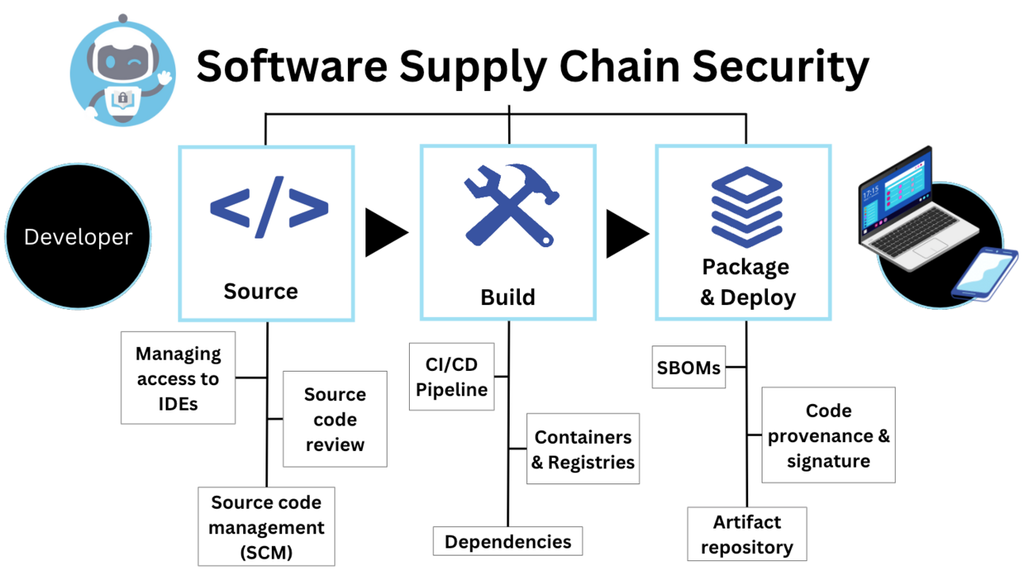
Software supply chain security is the practice of protecting every component, process and organization involved in creating, distributing and maintaining software.
A modern application may contain:
- Internally written source code
- Open-source libraries
- Third-party packages
- APIs
- Development frameworks
- Container images
- Build systems
- CI/CD pipelines
- Code repositories
- Developer tools
- Cloud services
- Software updates
- External vendors
The software supply chain therefore extends far beyond the final application.
For example, a developer might install an open-source package from a public repository. That package could depend on several other packages. Those dependencies may themselves rely on additional libraries.
The result can be a large dependency tree.
If one trusted component is compromised, attackers may gain an opportunity to reach applications or organizations that depend on it.
NIST describes software supply chain security as an area involving software components, suppliers, development practices, verification, vulnerability management and transparency. SBOMs are one important mechanism for understanding what components are present in software.
Why Software Supply Chain Security Matters in 2026
Software development has become increasingly interconnected.
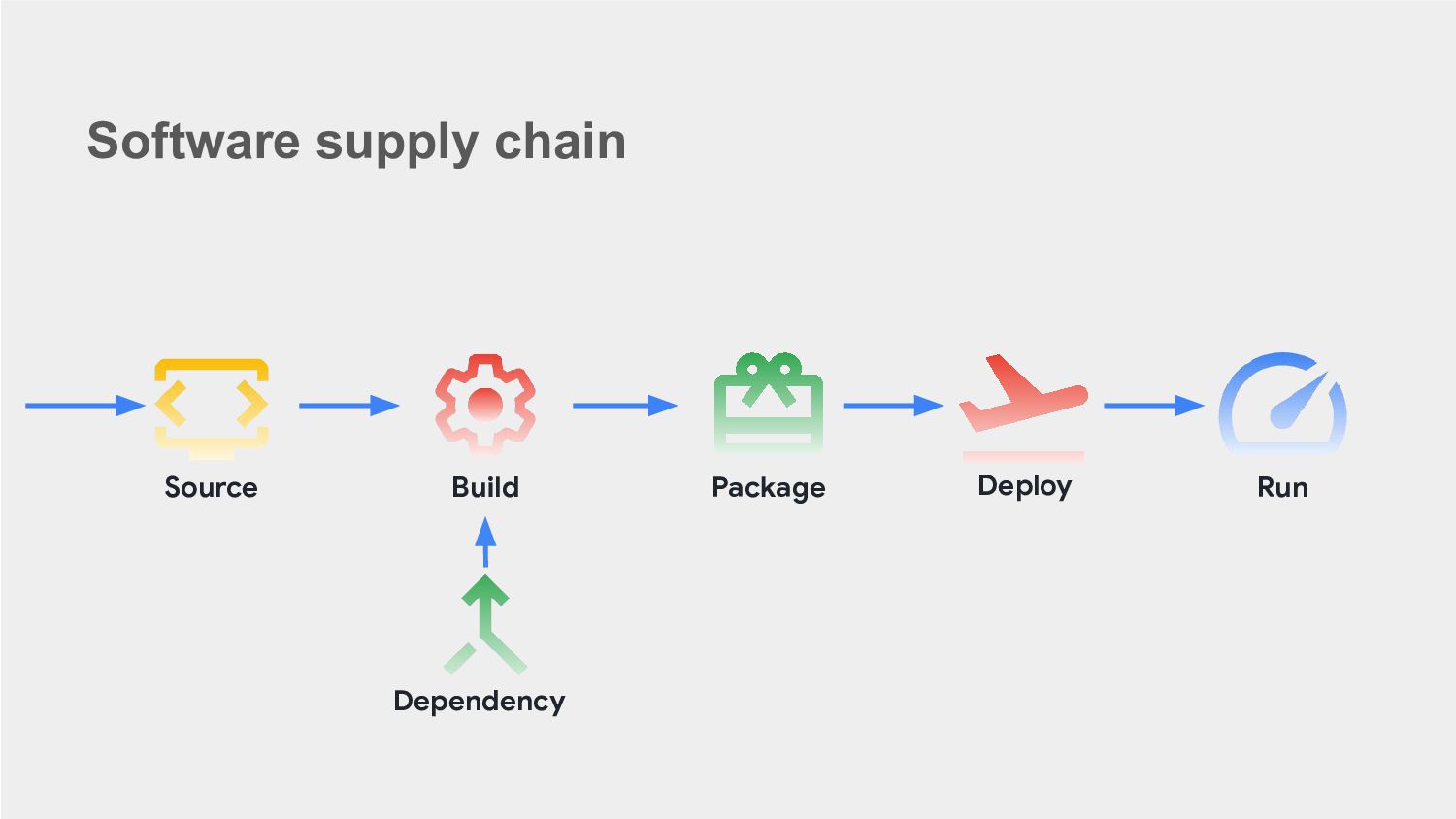
Organizations use thousands of external components and services. Developers also rely on package managers, Git repositories, automated testing systems and CI/CD platforms to move code from development to production.
This creates several potential attack surfaces.
1. Open-source dependencies
Open-source software provides enormous benefits to developers. Instead of building every component from scratch, developers can reuse existing libraries.
However, attackers can target popular packages, maintainers or repositories.
Google Threat Intelligence reported that open-source supply chain compromises involving repositories, dependencies and developer tools became increasingly significant during 2025 and the first half of 2026.
2. Developer environments
Developers often have access to source code, credentials, API keys, cloud accounts and deployment systems.
If a developer workstation is compromised, attackers may potentially use those privileges to move further into an organization’s environment.
Google’s September 2026 research on CI/CD security highlighted attacks targeting developer workstations and IDEs through social engineering, malicious extensions and typosquatted dependencies.
3. Automated build systems
CI/CD pipelines automatically build and deploy software.
Automation improves productivity, but it also means compromised credentials or build processes can have a large impact.
An attacker who gains unauthorized access to a build pipeline may attempt to modify software before it reaches customers.
4. Third-party vendors
Organizations frequently depend on external software suppliers.
This creates another layer of risk because a company may have strong internal security while still depending on a third-party component whose security practices are less mature.
NIST’s July 2026 supply-chain due-diligence guidance specifically addresses supplier assessments, including provenance, resilience, foundational cybersecurity practices and supply-chain tiers.
How Software Supply Chain Attacks Work
A software supply chain attack can take several forms.
There is no single attack method.
Compromising a Developer Account
Attackers may target the account of a developer or software maintainer.
If the account has permission to publish packages or modify repositories, attackers may attempt to insert malicious code into a legitimate project.
The package may initially appear trustworthy because users already know and trust the project.
Publishing a Malicious Package
Attackers may create packages with names that resemble legitimate libraries.
This technique can involve typosquatting, where a malicious package uses a name similar to a popular package.
For example, a developer could accidentally install:
popular-libraryy
instead of:
popular-library
If the malicious package contains harmful code, the developer may unknowingly introduce it into a project.
Compromising a Legitimate Package
A more serious scenario occurs when attackers gain access to a legitimate maintainer account or repository.
The attacker can potentially publish a new version of an existing package.
Google Threat Intelligence documented a 2026 incident involving a malicious dependency introduced into a legitimate Axios package after a maintainer account was compromised through social engineering. Google said the affected package had more than 100 million weekly downloads, illustrating why trusted packages can become high-impact targets.
Targeting CI/CD Pipelines
Attackers may also target automated development infrastructure.
Potential targets include:
- GitHub Actions
- Build servers
- Deployment systems
- Package registries
- CI/CD credentials
- Cloud service accounts
- Build artifacts
- Secrets stored in pipelines
If attackers obtain unauthorized access, they may attempt to alter software or steal credentials.
The Growing Risk of Developer Tools
Developer tools are increasingly important parts of the software supply chain.
Developers may use:
- IDE extensions
- Code assistants
- Package managers
- Security scanners
- Build tools
- Container tools
- Testing frameworks
- Deployment utilities
Google’s September 24, 2026 guidance warned that attackers are targeting trusted security and programming tools because these systems can have elevated privileges within build pipelines.
This creates an important security principle:
A trusted development tool should not automatically receive unlimited access.
Organizations should evaluate what each tool can access and restrict permissions wherever possible.
What Is an SBOM?
One of the most important concepts in software supply chain security is the Software Bill of Materials, commonly called an SBOM.
An SBOM is essentially an inventory of software components.
It can help organizations understand:
- Which libraries are included
- Which versions are being used
- Which dependencies exist
- Where components came from
- Which software may be affected by a vulnerability
NIST compares an SBOM conceptually to an ingredient list for software. It can improve transparency and help organizations identify vulnerable components more quickly.
For example, imagine an organization discovers a critical vulnerability in a specific open-source library.
Without an accurate software inventory, security teams may have difficulty determining which applications contain that library.
With an SBOM, the organization has a structured way to identify potentially affected software.
Why SBOMs Are Becoming More Important
SBOMs are not a complete security solution.
An organization can have an SBOM and still be vulnerable.
However, SBOMs improve visibility.
They can help security teams answer questions such as:
- What software components are installed?
- Which applications use a vulnerable library?
- Where did the component originate?
- Which version is currently deployed?
- Which vendors supplied the component?
- Which applications need remediation?
CISA also identifies SBOMs as an important part of software supply chain security and maintains resources for organizations implementing and consuming SBOM information.
Software Supply Chain Security and DevSecOps
DevSecOps integrates security into the software development lifecycle instead of waiting until the application is finished.
A secure development process can include:
- Secure coding
- Dependency scanning
- Code review
- Secret detection
- Vulnerability scanning
- SBOM generation
- Artifact verification
- CI/CD security
- Runtime monitoring
- Incident response
The goal is to identify security problems as early as possible.
Security should not be treated as a final checkpoint before deployment.
Key Security Practices for Developers
Developers can take several practical steps to reduce software supply chain risks.
Verify Dependencies
Do not automatically install every package recommended online.
Check:
- Package name
- Maintainer
- Repository
- Release history
- Download patterns
- Known vulnerabilities
- Documentation
- Maintenance activity
Lock Dependency Versions
Where appropriate, use dependency lock files to reduce unexpected changes.
Automatically pulling the newest version of every dependency can introduce unnecessary risk.
Remove Unused Packages
Unused dependencies increase the attack surface.
If a library is no longer required, removing it can simplify maintenance and reduce exposure.
Protect Developer Accounts
Developer accounts should use strong authentication and phishing-resistant security where supported.
Organizations should also limit administrative privileges.
Protect Secrets
API keys, passwords, cloud credentials and signing keys should not be stored directly inside source code.
Secrets should be managed through appropriate secret-management systems.
Review CI/CD Permissions
CI/CD systems should receive only the permissions they actually need.
A build pipeline that only needs to compile code should not automatically receive unrestricted access to every production resource.
Security Practices for Organizations
Companies should approach supply chain security as an ongoing process.
Maintain an Asset and Dependency Inventory
Organizations need visibility into their applications and their dependencies.
A centralized inventory can help security teams understand what software is running across the environment.
Perform Vendor Due Diligence
Before adopting critical software, organizations should evaluate the supplier’s security practices.
Questions can include:
- How is software developed?
- How are vulnerabilities handled?
- Does the vendor provide an SBOM?
- How are updates signed?
- How are security incidents communicated?
- Who has access to source repositories?
- How are third-party dependencies managed?
NIST’s 2026 due-diligence guidance recommends examining supplier provenance, resilience, foundational cybersecurity practices and supply-chain tiers.
Monitor for Vulnerabilities
Security teams should continuously monitor their dependencies for newly disclosed vulnerabilities.
A vulnerability discovered today may affect software that was considered safe when it was originally deployed.
Secure Build Infrastructure
Build environments should be treated as security-sensitive systems.
Organizations should protect:
- Build servers
- Source repositories
- Package registries
- Signing keys
- CI/CD credentials
- Deployment credentials
- Cloud service accounts
Software Supply Chain Security vs Traditional Cybersecurity
| Traditional Cybersecurity | Software Supply Chain Security |
|---|---|
| Protects systems and networks | Protects software development ecosystems |
| Focuses on endpoints and infrastructure | Focuses on code, dependencies and tooling |
| Detects attacks against deployed systems | Can detect risks before deployment |
| Uses endpoint and network controls | Uses dependency scanning, SBOMs and pipeline controls |
| Protects internal infrastructure | Also evaluates third-party software |
These areas overlap.
An organization needs both traditional cybersecurity controls and software supply chain security.
Major Challenges
Software supply chain security is not easy.
Dependency Complexity
Large applications may depend on hundreds or thousands of components.
Tracking all of them can be difficult.
Legacy Software
Older applications may not have modern dependency inventories or automated security controls.
Third-Party Risk
Organizations cannot directly control every external vendor or open-source maintainer.
Alert Overload
Security teams may receive large numbers of vulnerability notifications.
Not every vulnerability has the same practical impact, so teams need risk-based prioritization.
Developer Productivity
Security controls that create excessive friction can encourage developers to bypass them.
The goal should be secure development that still allows teams to work efficiently.
A Practical Software Supply Chain Security Checklist
Organizations can use the following checklist as a starting point:
- Maintain an inventory of applications and dependencies
- Generate and maintain SBOMs
- Scan open-source dependencies
- Remove unnecessary packages
- Protect developer accounts
- Use strong authentication
- Protect API keys and secrets
- Restrict CI/CD permissions
- Secure source-code repositories
- Monitor package registries
- Review third-party suppliers
- Verify software provenance
- Secure build artifacts
- Monitor vulnerabilities continuously
- Prepare an incident-response plan
- Regularly review developer tools and extensions
The Role of Software Provenance
Software provenance is another important part of supply chain security.
Organizations need confidence about where software came from and how it was produced.
This becomes particularly important when applications pass through multiple build systems and external dependencies.
Provenance information can help organizations understand:
- Who created the software
- Which source code was used
- Which build process produced it
- Which dependencies were included
- Whether the artifact was modified
This can make investigations and verification easier.
How Small Businesses Can Improve Security
Software supply chain security is not only for large technology companies.
Small businesses can also take practical steps.
Start with the basics:
Use Trusted Software Sources
Download software and packages from legitimate repositories and verified vendors.
Keep Software Updated
Apply security updates according to a defined maintenance process.
Limit Administrative Access
Developers and employees should not have more privileges than necessary.
Back Up Critical Data
Maintain tested backups so that a compromise does not automatically become a permanent data-loss event.
Train Employees
Many supply chain incidents begin with compromised accounts.
Security awareness remains important for developers, administrators and other employees.
The Future of Software Supply Chain Security
The software ecosystem is likely to become even more interconnected.
Cloud-native applications, open-source components, automated development pipelines and AI-assisted development are changing how software is produced.
That means supply chain security will increasingly need to become part of the development lifecycle rather than a separate security activity.
Organizations are also moving toward more structured supply-chain risk management.
NIST released updated guidance in 2026 covering security, privacy and cybersecurity supply chain risk management plans, while its July 2026 SP 1326 provides a practical framework for supplier due diligence.
The future of software security will therefore involve greater visibility into components, stronger verification, better dependency management and more disciplined control over development infrastructure.
What Users Should Know
For everyday users, software supply chain attacks can be difficult to recognize because the compromised software may initially look legitimate.
Users should:
- Keep operating systems updated
- Install applications from trusted sources
- Avoid suspicious software modifications
- Be careful with browser extensions
- Use strong account security
- Enable multifactor authentication
- Avoid downloading unknown packages
- Pay attention to unusual software update prompts
Businesses and developers need even stronger controls because their systems can provide attackers with access to valuable data and infrastructure.

Frequently Asked Questions
What is software supply chain security?
Software supply chain security protects the software development ecosystem, including source code, dependencies, open-source packages, developer tools, build systems, CI/CD pipelines and third-party suppliers.
Why are software supply chain attacks dangerous?
They can abuse trusted software or development infrastructure. Because organizations already trust many dependencies and tools, a compromised component may provide attackers with a path into downstream systems.
What is an SBOM?
An SBOM, or Software Bill of Materials, is an inventory of the components and dependencies contained in software. It can help organizations identify affected applications when vulnerabilities are discovered.
Can open-source software be secure?
Yes. Open-source software can be secure, but organizations still need to evaluate dependencies, maintain updates, monitor vulnerabilities and understand the provenance of components.
How can developers reduce supply chain risks?
Developers can verify packages, lock dependencies, remove unused libraries, protect credentials, use dependency scanning, secure source repositories and restrict CI/CD permissions.
What is a software supply chain attack?
A software supply chain attack occurs when attackers compromise software components, development infrastructure, suppliers or related systems to reach users or organizations that depend on them.
Is an SBOM enough to protect software?
No. An SBOM improves visibility but does not itself prevent attacks. It should be combined with vulnerability management, secure development practices, access controls, monitoring and supply-chain risk management.
Why is CI/CD security important?
CI/CD systems can have powerful permissions to build and deploy software. Protecting these systems helps prevent unauthorized changes to applications and reduces the potential impact of compromised credentials or build infrastructure.
Final Thoughts
Software supply chain security has become an important part of modern cybersecurity.
Applications now depend on enormous ecosystems of open-source libraries, third-party services, developer tools and automated infrastructure. This interconnected model provides major advantages for software development, but it also creates opportunities for attackers.
Recent 2026 threat intelligence shows that attackers are actively targeting open-source repositories, dependencies, developer environments and development pipelines.
The most effective approach is not to stop using open-source software or modern development tools. Instead, organizations should improve visibility, verify dependencies, protect developer identities, secure CI/CD pipelines, maintain SBOMs and continuously monitor software risks.
In modern cybersecurity, protecting the final application is only part of the job.