
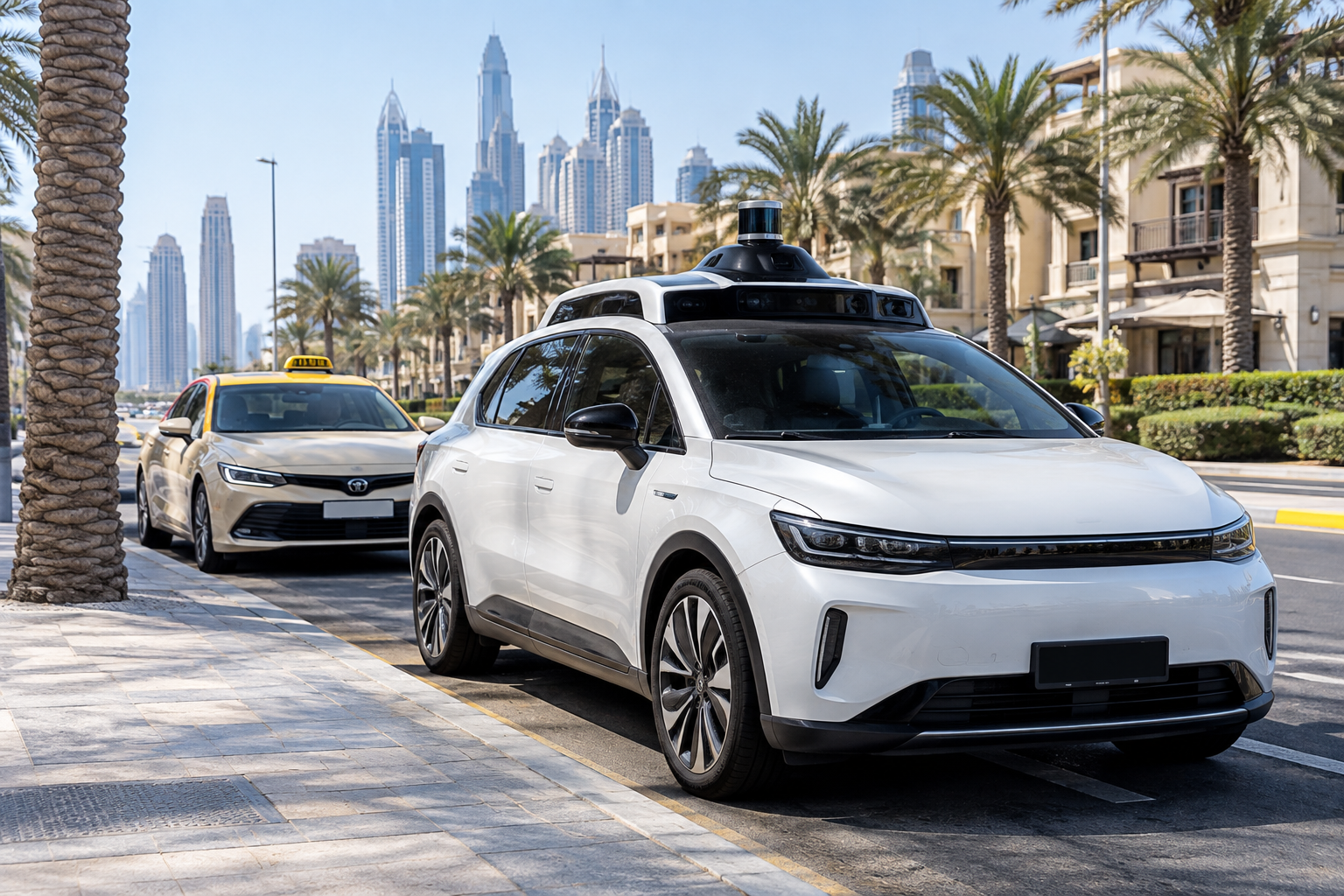
Most guides to Dubai driver jobs read like a vacancy board: taxi, truck, bus, delivery, apply here. That advice isn’t wrong, but in 2026 it leaves out the biggest change to the profession in decades. Driverless taxis are now carrying paying passengers in Dubai.
That doesn’t mean driver jobs are about to vanish. The current numbers are small, and several kinds of driving work are far less exposed than taxi work. But anyone planning a career behind the wheel in Dubai should understand what has launched, what the taxi operator has said about its workforce, and where the jobs are likely to move.
This article covers the facts first, then offers a clearly labelled assessment of which roles look more or less exposed, and ends with practical steps.
What has actually launched
Dubai’s Roads and Transport Authority (RTA) announced commercial driverless taxi operations at the end of March 2026, starting in Umm Suqeim and Jumeirah. According to Khaleej Times, the first phase included 100 autonomous taxis run through Apollo Go and WeRide, bookable through the Uber and Apollo Go apps.
Before that, Apollo Go received Dubai’s first driverless testing permit for vehicles with no safety driver in January 2026, and Dubai Taxi Company launched its own driverless ride-hailing through the Apollo Go app, starting with 50 vehicles in the first year, according to Gulf News.
By August 2026, Uber had added a dedicated “Autonomous” option in its app to improve a rider’s chances of being matched with a robotaxi. In the same report, Dubai Media Office figures showed the robotaxi operation had covered more than 4 million kilometres and carried 7,613 passenger trips since launch.
The RTA is working with three autonomous driving companies: Baidu’s Apollo Go, WeRide, and Pony.ai. The long-term target, per the RTA’s Self-Driving Transport Strategy, is to convert 25 percent of all trips in Dubai into autonomous journeys by 2030.
Putting the numbers in proportion
A headline about driverless taxis can sound like a takeover. The data says the rollout is still early.
| Measure | Figure | Source context |
|---|---|---|
| Robotaxi fleet (mid-2026) | 144 vehicles, 48 in active operation | RTA, as reported by Khaleej Times |
| Dubai Taxi Company fleet (Dec 2025) | 6,217 vehicles | Reported by AGBI |
| Dubai Taxi Company workforce (Dec 2025) | More than 20,000 | Reported by AGBI |
| Passenger journeys on public transport, shared mobility and taxis, H1 2026 | About 348 million | RTA, as reported by Khaleej Times |
| Robotaxi trips since launch | 7,613 | Dubai Media Office |
Compare those rows. A fleet of roughly 144 robotaxis, with fewer than a third in active service, sits next to a conventional taxi fleet of more than 6,000. The service is also limited to selected areas, and the RTA describes the programme as moving gradually from vehicles with safety drivers towards fully driverless rides. In other words, nobody has measured job losses yet. What exists is a direction of travel and a 2030 target.

What the taxi operator has said about drivers
The most direct statement came in a 2025 interview with AGBI. Dubai Taxi Company’s CEO said that if autonomous vehicles replace some existing cars, the company will reduce the number of drivers, but that it was too early to see the full picture. At that time the company ran about 2.5 drivers per vehicle, with roughly 18,000 drivers, according to the same report.
That 2.5 figure explains why the shift matters: taxis in Dubai often run in shifts, so one vehicle supports more than one driver. Replacing a conventional taxi with a robotaxi could remove more than one job, if the replacement happens one-for-one. The CEO’s wording leaves open that it may not. In February 2026, he said the company planned 50 to 100 cars for the autonomous launch, with the costs split between Dubai Taxi and the operator.
Both of these are statements of intent and early planning, not confirmed layoffs.
Which driver jobs look more or less exposed
The following is my assessment, not an official forecast. It rests on one simple idea: the more a job consists of moving one passenger along a mapped urban route, the more it resembles what robotaxis are being built to do.
| Role | Relative exposure | Why |
|---|---|---|
| Taxi and ride-hailing drivers | Highest | Directly competing with the service being launched |
| Limousine and airport transfer | Medium | Similar routes, but passengers often expect personal service and luggage help |
| Private or family driver | Lower | Involves errands, trust, and tasks beyond driving |
| Corporate chauffeur | Lower to medium | Premium and discretion matter, but cost pressure could change this over time |
| School and staff bus driver | Lower | Supervising children and managing passengers is part of the job |
| Heavy truck and logistics | Lower in the near term | Different technology, longer timelines, and loading and site work |
| Delivery rider | Uncertain | Depends on how last-mile delivery automation develops |
Nothing in the sources says these roles will change on any schedule, so treat the table as a way to think, not a prediction.
New roles around driverless fleets
Autonomous vehicles still need people. Baidu’s Apollo Go opened an operations and control centre at Dubai Science Park, a 2,000-square-metre facility that will manage fleet operations, vehicle monitoring, software updates, maintenance, and safety testing. It is the company’s first such centre outside China.
That list is a map of where related jobs may appear: fleet supervision, remote monitoring, maintenance and vehicle preparation, charging and cleaning, customer support, and safety operations. Many of these will want technical skills that a typical driving job doesn’t build, so they are not an automatic fit for existing drivers. They are, however, a realistic place to aim for someone willing to train.
What drivers and job seekers can do
Hold more than one licence category. Light vehicle licences are the most common and the most competitive. Heavy vehicle and bus categories open different sectors. Check the exact categories on the RTA website before paying for training, since guides disagree on the numbering.
Learn the digital side of the work. Taxi, delivery, and logistics jobs increasingly run through apps, dispatch tools, and telematics. Comfort with smartphones, navigation software, and basic vehicle diagnostics is becoming a baseline.
Look at service-heavy driving roles. Jobs combining driving with customer care, such as school transport, hospitality, and personal driving, depend on human judgment in ways that are harder to replace.
Consider adjacent skills. Basic vehicle maintenance, EV handling, and fleet administration all tie into where Dubai’s transport sector is heading.
Watch your employer’s announcements. If you drive for a taxi company, pay attention to fleet plans. If your employer is replacing vehicles, ask what retraining or redeployment is offered.
Verify every offer before paying. As covered in our guide to driver jobs in the UAE, legitimate offers on the mainland come through the Ministry of Human Resources and Emiratisation with a verifiable barcode, and employers should not charge you recruitment costs. Fast-moving industries attract scammers.
Who should think hardest about this
If you are considering a move to Dubai specifically to drive a taxi, the next few years deserve careful thought. The service is expanding, the operator has been open about the likely effect on driver numbers, and the long-term target is ambitious.
If you hold a heavy vehicle licence, drive a school bus, or work in a role that includes service and responsibility beyond driving, the picture is steadier, though not frozen. Dubai’s population has passed 4 million, according to Khaleej Times, and demand for transport in all forms is rising.

Frequently Asked Questions
Are there driverless taxis in Dubai now?
Yes. Dubai’s RTA announced commercial driverless taxi operations in Umm Suqeim and Jumeirah at the end of March 2026, using Apollo Go and WeRide vehicles, with bookings through Uber and the Apollo Go app. Coverage is currently limited to selected areas.
Will robotaxis replace all taxi drivers in Dubai?
There is no evidence of that. The robotaxi fleet is small next to the conventional taxi fleet, and the RTA’s stated goal is for 25 percent of trips to be autonomous by 2030, which leaves the majority human-driven on that target. The taxi operator has said driver numbers would fall where autonomous cars replace existing ones, but that the full picture is unclear.
Are Dubai driver jobs still worth pursuing?
For many roles, yes. Dubai’s transport demand continues to grow, and not all driving work is equally exposed. Roles in heavy transport, school and staff transport, and personal driving look less directly affected than taxi work, though this is an assessment, not a guarantee.
What new jobs are being created?
Autonomous fleets need monitoring, maintenance, software updates, and safety testing. Apollo Go’s Dubai Science Park centre handles exactly these functions. Specific vacancies and requirements vary, so check company career pages directly.
Do I still need a UAE licence to get a driver job in Dubai?
In most listings, yes. Check the exact category with the RTA and verify any job offer through official channels before spending money.
Where can I find reliable updates on the robotaxi rollout?
The RTA and the Dubai Media Office publish official figures, and Dubai Taxi Company announces its own fleet plans. Compare those with news coverage and look for dates.