
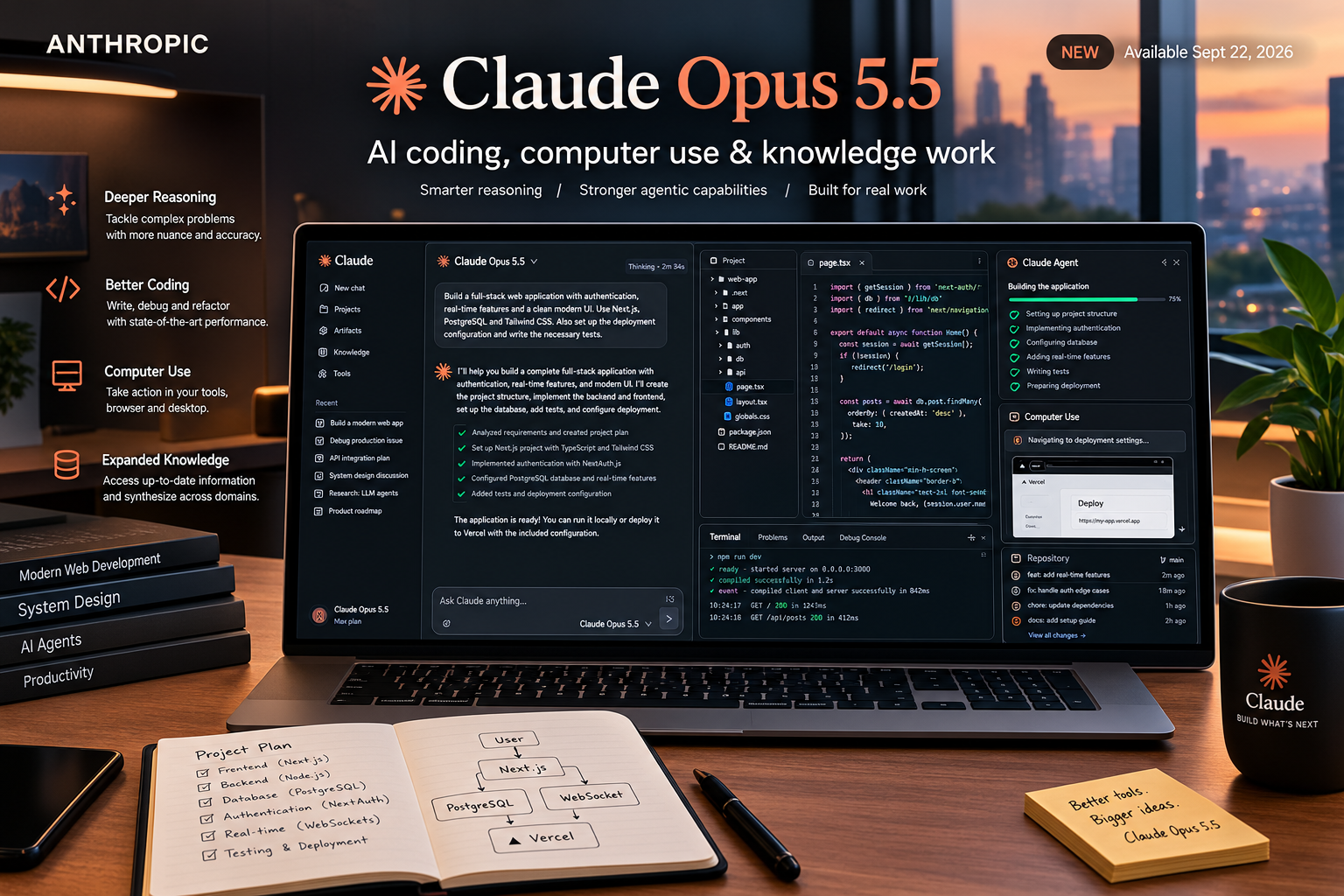
Artificial intelligence models are moving beyond simple question-and-answer chatbots. The latest generation is increasingly focused on coding, computer use, autonomous agents and complex professional workflows.
On September 22, 2026, Anthropic introduced Claude Opus 5.5, the first model in its new Claude 5.5 family. Anthropic says the model is designed for demanding coding, agentic tasks and professional knowledge work, while costing less to run than its predecessor, Claude Opus 5.
According to Anthropic, Opus 5.5 costs 40% less to run than Opus 5 on typical token-billed workloads. The company also says the model generates output more than 30% faster than Opus 5 and uses fewer tokens on many tasks.
The release is significant because Anthropic is positioning Opus 5.5 not simply as a chatbot, but as a model for long-running AI agents and complex work.
In this article, we explain what Claude Opus 5.5 is, its major features, pricing, coding capabilities, agentic functionality, availability, safety measures and what the release means for AI users and developers.
What Is Claude Opus 5.5?
Claude Opus 5.5 is Anthropic’s newest model in the Opus family and the first release in the company’s Claude 5.5 generation.
Anthropic describes it as its most capable Opus model for coding, AI agents and knowledge work. It is available for consumer and business users through Claude plans and for developers through the Claude Platform and cloud providers including Amazon Web Services, Google Cloud and Microsoft Foundry.
The model is designed for tasks that require more than a short response.
These include:
- Software development
- Large codebase migrations
- Debugging
- Code review
- Complex document creation
- Data analysis
- Financial analysis
- Computer use
- Multi-step AI agents
- Enterprise workflows
- Research-oriented tasks
The overall direction is clear: Anthropic is targeting workflows where an AI system needs to understand a large amount of context, plan several steps and continue working toward an objective.
Claude Opus 5.5 Release Date
Anthropic officially announced Claude Opus 5.5 on September 22, 2026.
The model became available immediately across Anthropic’s supported platforms, including the Claude application, Claude Platform and major cloud platforms.
This makes Opus 5.5 one of the latest major AI model releases in September 2026.
Claude Opus 5.5 Key Features
1. Advanced Coding Capabilities
Coding is one of the main areas where Anthropic is positioning Opus 5.5.
The company says the model is particularly capable of handling long and complex software-development tasks, including large codebase migrations and audits.
Anthropic reports that an early tester used Opus 5.5 to audit and fix a 200,000-line codebase in less than three hours. The company also describes a separate example involving a 680,000-line code migration completed in less than a day.
These are early tester reports cited by Anthropic, not independent benchmarks or guarantees of performance for every project.
For developers, the important concept is that the model is intended to work across large software projects instead of only generating isolated snippets.
Potential applications include:
- Refactoring
- Debugging
- Code migration
- Code review
- Test generation
- Documentation
- Repository-wide changes
- Performance optimization
- Software maintenance
2. AI Agents
Another major focus of Claude Opus 5.5 is agentic AI.
Traditional AI assistants generally respond to individual prompts.
An AI agent can potentially break a larger objective into multiple steps, use tools, inspect results and continue working.
Anthropic describes Opus 5.5 as its strongest Opus model for agentic work and says it can coordinate complex multi-tool tasks, use memory across sessions and work on longer-running assignments.
This could make the model useful for software agents that need to:
- Understand a task
- Inspect available information
- Plan an approach
- Use tools
- Modify files or code
- Test the result
- Review its work
- Report what was completed
However, the actual level of autonomy depends on the tools, permissions and environment provided to the model.
3. Improved AI Efficiency
One of the most notable parts of the release is efficiency.
Anthropic says Opus 5.5 costs about 40% less to run than Opus 5 on typical workloads.
Its published API pricing is:
| Pricing | Claude Opus 5.5 |
|---|---|
| Input tokens | $4 per million |
| Output tokens | $20 per million |
| Cache reads | $0.20 per million |
| Cache writes | $5 per million |
Anthropic also offers a faster mode with pricing of $8 per million input tokens and $40 per million output tokens.
These are API token prices and should not be confused with consumer Claude subscription prices.
For developers running large AI workloads, lower token costs can be important because agentic applications may generate many model calls during a single task.
4. Faster Responses
Anthropic says Claude Opus 5.5 generates output more than 30% faster than Opus 5.
The company also introduced a fast mode for Opus 5.5 in Claude Code and the Claude Platform, with up to 2.5 times faster speed according to Anthropic.
Faster response generation can be particularly useful for:
- Coding agents
- Interactive development
- Computer-use workflows
- Long research tasks
- Enterprise assistants
- Real-time collaboration
Speed, however, is only one factor. For professional applications, accuracy and reliability remain equally important.
5. Computer Use and Vision
Claude Opus 5.5 also focuses on vision and computer-use capabilities.
Anthropic says the model is designed to interpret documents, charts, screenshots and diagrams and can perform multi-step tasks involving computer interfaces.
This is an important development because AI assistants are increasingly being designed to interact with software interfaces rather than simply generate text.
For example, an AI system could potentially analyze a spreadsheet screenshot, understand the information displayed on screen and assist with a related task.
The exact actions an AI can perform depend on the tools and permissions made available to it.
6. Professional Knowledge Work
Anthropic is also positioning Opus 5.5 for professional knowledge work.
The company lists enterprise workflows, financial analysis and complex document creation among the model’s intended use cases.
This means the model is aimed at tasks involving large amounts of information rather than only casual conversations.
Potential examples include:
- Business research
- Report preparation
- Document analysis
- Financial research
- Spreadsheet work
- Presentation creation
- Technical documentation
- Professional writing
Users should still independently verify important information, particularly in financial, legal, medical or other high-stakes contexts.
Claude Opus 5.5 for Developers
Developers can access Opus 5.5 through Anthropic’s API using the model identifier claude-opus-5-5.
Anthropic says it is available through its own Claude Platform as well as Amazon Web Services, Google Cloud and Microsoft Foundry.
This gives developers multiple ways to integrate the model into applications and AI agents.
Possible applications include:
Coding Assistants
Developers can use the model to assist with code generation, debugging and refactoring.
Autonomous Development Agents
Developers can build agents capable of working through multiple development tasks.
Business Assistants
Companies can integrate AI into internal workflows and knowledge systems.
Research Applications
The model can process large amounts of information and produce structured outputs.
Data Analysis
AI agents can potentially combine reasoning with code and tools to analyze datasets.
Claude Opus 5.5 vs Claude Opus 5
The most important differences highlighted by Anthropic are efficiency, coding performance and agentic capabilities.
| Feature | Claude Opus 5.5 | Claude Opus 5 |
|---|---|---|
| Model family | Claude 5.5 | Claude 5 |
| Input price | $4/M tokens | $5/M tokens |
| Output price | $20/M tokens | $25/M tokens |
| Cache reads | $0.20/M | $0.50/M |
| Fast mode | Up to 2.5x | — |
| Coding | Enhanced | Strong |
| AI agents | Enhanced | Strong |
| Computer use | Enhanced | Available |
| Professional work | Enhanced | Strong |
| Availability | Claude + API + cloud platforms | Claude + API + cloud platforms |
The pricing and capability information above comes from Anthropic’s September 22, 2026 announcement.
Claude Opus 5.5 Benchmark Results
Anthropic published benchmark results comparing Opus 5.5 with several other models.
For example, Anthropic reports that Opus 5.5 scored 54.6% on its reported FrontierCode v1.1 main set at default effort, compared with 53.3% for GPT-6 Astra in the comparison shown by Anthropic.
Anthropic also reports a 52.5% score for Opus 5.5 on CursorBench 4.0, compared with 41.7% for GPT-5.6 Sol in the company’s comparison.
These results should be interpreted carefully.
Benchmark performance depends on evaluation methodology, model configuration, effort settings, tools and test sets. Anthropic itself notes methodological details and standard errors for some of its comparisons. Therefore, benchmark numbers should not automatically be treated as a universal measure of real-world performance.
Claude Opus 5.5 Pricing
For API users, Anthropic lists:
- $4 per million input tokens
- $20 per million output tokens
- $0.20 per million cache-read tokens
- $5 per million cache-write tokens
Fast mode costs:
- $8 per million input tokens
- $40 per million output tokens
Anthropic says these prices are lower than Opus 5 and that typical workloads can cost about 40% less.
Consumer pricing is different because Claude Opus 5.5 is available through Claude subscription plans such as Pro, Max, Team and Enterprise.
Users should check Anthropic’s current pricing page before purchasing because subscription features and limits can change.
Safety and Security
As AI models become more capable, safety becomes increasingly important.
Anthropic says Opus 5.5 launched with safeguards covering areas including cybersecurity, biology and model-distillation risks.
Anthropic also says the model was evaluated through external testing and its own automated behavioral audit.
The company describes Opus 5.5 as its strongest-performing model to date on that particular internal automated behavioral audit. This is an Anthropic evaluation claim and should not be interpreted as an independent universal safety ranking.
The model is also available with zero data retention under supported arrangements, according to Anthropic.
For organizations, privacy configuration, access controls and data-handling policies remain important regardless of the AI model being used.

What Does Claude Opus 5.5 Mean for AI Coding?
The release reflects a broader shift in software development.
AI coding tools are moving from generating individual functions toward working on larger projects.
Instead of asking:
“Write a Python function for this task.”
Developers can increasingly ask AI systems to:
- Inspect a repository
- Identify a problem
- Plan a solution
- Modify multiple files
- Run tests
- Find errors
- Fix problems
- Explain the changes
Opus 5.5 is explicitly designed around this longer workflow.
This does not eliminate the need for developers. Human review remains important because generated code can introduce bugs, security problems or unintended behavior.
Potential Benefits of Claude Opus 5.5
Lower AI Operating Costs
Anthropic’s lower token pricing may make long-running AI workloads more economical.
Stronger Coding Workflows
The model is designed for large-scale coding, refactoring and debugging.
Better Agentic Work
The model can be integrated into multi-step workflows involving tools and external systems.
Faster Output
Anthropic reports more than 30% faster output generation compared with Opus 5.
Professional Use Cases
The model is designed for enterprise, financial, research and other knowledge-work applications.
Limitations and Things to Consider
Claude Opus 5.5 is powerful, but users should not assume that every task will be completed correctly.
AI Can Still Make Errors
Even advanced AI systems can produce incorrect information or flawed code.
Benchmark Results Are Not Everything
A model can perform strongly on a benchmark but behave differently in a real-world application.
Costs Depend on Usage
API expenses depend on token consumption, caching, workload design and usage volume.
Agent Permissions Matter
An AI agent can only safely operate within the permissions and tools given to it. Poorly configured access can create unnecessary security risks.
Human Review Remains Necessary
Important software changes, financial analysis and business decisions should receive appropriate human oversight.
Who Should Use Claude Opus 5.5?
Claude Opus 5.5 is particularly relevant to:
- Software developers
- AI engineers
- Technology companies
- Enterprise teams
- Researchers
- Data analysts
- Financial professionals
- AI agent developers
- Technical writers
- Businesses experimenting with automation
Casual users may not need the most capable model for every simple task. The value of a powerful model depends on whether the user’s workload actually requires its capabilities.
The Future of Claude and AI Agents
Anthropic says Claude Sonnet 5.5 and Claude Haiku 5.5 will follow in the coming weeks, with improvements in performance, efficiency and safety.
This suggests that Claude 5.5 will become a broader model family rather than a single product release.
More importantly, the Opus 5.5 launch shows where AI development is heading: longer tasks, more tool use, better coding capabilities and increasingly autonomous workflows.
The challenge will be balancing capability with reliability and safety.
As AI systems gain the ability to interact with software, access information and perform multiple actions, organizations will need stronger controls around permissions, monitoring and human oversight.
Frequently Asked Questions
What is Claude Opus 5.5?
Claude Opus 5.5 is Anthropic’s newest Opus AI model, introduced on September 22, 2026. It is designed for coding, AI agents and professional knowledge work.
When was Claude Opus 5.5 released?
Anthropic announced Claude Opus 5.5 on September 22, 2026, and made it available across supported Claude and developer platforms.
How much does Claude Opus 5.5 cost?
Anthropic lists API pricing of $4 per million input tokens and $20 per million output tokens. Cache reads cost $0.20 per million tokens.
Is Claude Opus 5.5 good for coding?
Anthropic specifically positions Opus 5.5 for advanced coding, including large codebases, migrations, debugging, refactoring and code review.
Can Claude Opus 5.5 create AI agents?
Yes. Anthropic describes Opus 5.5 as an agentic model capable of handling complex multi-tool tasks and longer-running workflows.
Is Claude Opus 5.5 available through an API?
Yes. Developers can access the model through Anthropic’s Claude Platform, as well as supported cloud platforms including Amazon Web Services, Google Cloud and Microsoft Foundry.
Is Claude Opus 5.5 faster than Opus 5?
Anthropic says Opus 5.5 generates output more than 30% faster than Opus 5 and also offers a fast mode with up to 2.5x faster speed.
Should businesses use Claude Opus 5.5 without human review?
No. Even highly capable AI systems can make mistakes. Businesses should use appropriate testing, access controls and human review for important workflows.
Final Thoughts
Claude Opus 5.5 is one of the latest major developments in the AI model race, with Anthropic focusing heavily on coding, agents, computer use and professional work.
The release is particularly notable for its emphasis on efficiency. Anthropic says the model can deliver improved performance while costing about 40% less to run than Opus 5 on typical workloads.
For developers, the biggest potential impact may come from long-running coding and agentic workflows. Instead of using AI only to generate small pieces of code, developers can increasingly use models to work across repositories, investigate problems and complete multi-step tasks.
At the same time, powerful AI requires responsible deployment. Accuracy, privacy, security, permissions and human oversight remain essential.
As Claude 5.5 expands with additional models in the coming weeks, the AI software landscape is likely to become even more focused on AI agents that can perform meaningful work rather than simply answer questions.
Image Captions
Featured Image Caption:
Claude Opus 5.5 is Anthropic’s latest AI model focused on coding, AI agents and professional knowledge work.
Image 2 Caption:
Claude Opus 5.5 is designed to handle complex software development and large codebase tasks.
Image 3 Caption:
Anthropic is positioning Claude Opus 5.5 for long-running AI agents and multi-step workflows.
Image 4 Caption:
Claude Opus 5.5 supports developers through advanced coding, debugging and software engineering workflows.
Image 5 Caption:
Anthropic says Claude Opus 5.5 offers lower token costs and faster output compared with Opus 5.
Image 6 Caption:
Claude Opus 5.5 can assist with professional documents, data analysis and other knowledge-work tasks.
Image 7 Caption:
AI agents powered by advanced models can perform multiple steps while using connected tools and applications.
Internal Linking Opportunities
- Anchor Text: Latest AI Models in 2026
Destination Topic: A regularly updated guide covering major AI model releases. - Anchor Text: AI Coding Tools
Destination Topic: AI-powered programming and developer tools. - Anchor Text: AI Agents Explained
Destination Topic: Beginner-friendly guide to agentic AI and autonomous workflows. - Anchor Text: Best AI Productivity Tools
Destination Topic: AI applications for writing, research, planning and productivity. - Anchor Text: AI Cybersecurity
Destination Topic: How AI is being used for cybersecurity and threat detection. - Anchor Text: AI API Guide
Destination Topic: Introduction to AI APIs and how developers can integrate AI models into applications.
Sources / References
- Anthropic — Claude Opus 5.5 official announcement, September 22, 2026.
- Anthropic — Claude Opus model page and availability information.
- Anthropic — Official Newsroom.
- Anthropic Trust Center — Claude Opus 5.5 model documentation.